Fun Thinking Skills Workbook: A Practical Guide for Developing Cognitive Abilities in Kids
The Fun Thinking Skills Workbook is an educational resource designed to help children develop essential cognitive skills through engaging and interactive activities. Unlike traditional workbooks that focus solely on rote learning, this workbook emphasizes logical thinking, creativity, and problem-solving in a way that keeps young learners motivated and interested. With its unique approach, it stands out as a valuable tool for parents, educators, and homeschoolers looking for alternative ways to nurture critical thinking in children.
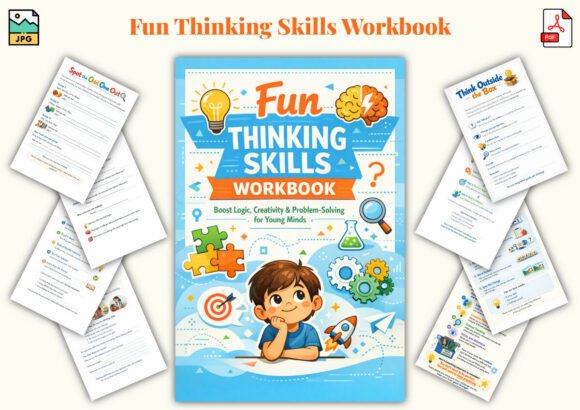
What makes the Fun Thinking Skills Workbook distinct is its variety of activities tailored to different learning styles and developmental stages. The 32-page workbook includes brain-boosting exercises, observation challenges, logic puzzles, creative thinking prompts, infographic-style learning pages, and interactive worksheets. Each activity is carefully crafted to ensure that children not only learn but also enjoy the process of discovery and problem-solving.
Key Features of the Fun Thinking Skills Workbook
The Fun Thinking Skills Workbook offers a range of features that set it apart from other similar resources:
- Brain-boosting exercises: These activities are designed to improve memory, attention span, and logical reasoning. For example, children might be asked to identify patterns or complete sequences, which helps build foundational thinking skills.
- Observation and focus challenges: These tasks encourage children to pay close attention to details, whether it's identifying differences between images or following multi-step instructions. This aspect of the workbook supports the development of executive functioning skills.
- Logic puzzles and sequences: By solving these puzzles, children learn to think step by step and evaluate multiple possibilities before arriving at a solution. This type of activity is particularly beneficial for developing analytical thinking.
- Creative thinking activities: These include open-ended questions and prompts that allow children to explore their imagination and express themselves in new ways. Creativity is often overlooked in traditional education, making this a crucial addition to any learning toolkit.
- Infographic-style learning pages: Visual learners will appreciate these pages, which present information in a clear and engaging format. They help break down complex concepts into digestible pieces, making learning more accessible.
- Interactive worksheets and reflection pages: These elements provide opportunities for children to apply what they've learned and reflect on their progress. Reflection is a key component of deep learning, and this feature encourages metacognition.
- Real-life thinking applications: Many of the activities are based on real-world scenarios, helping children see how the skills they're developing can be used outside the classroom.
- Fun quizzes and challenges: These add an element of play and competition, which can be highly motivating for children who thrive on achievement and recognition.
How Does It Compare to Other Learning Resources?
When comparing the Fun Thinking Skills Workbook to other educational tools, it’s important to consider the balance between structure, engagement, and effectiveness. Traditional workbooks often focus on academic subjects like math and reading, but they may lack the interactive and creative elements that make learning enjoyable. In contrast, the Fun Thinking Skills Workbook prioritizes skill development through play, making it a good option for those seeking alternatives to conventional methods.
Compared to digital learning apps, which can be distracting due to screen time, this workbook provides a tangible, hands-on experience that promotes focus and concentration. While some online platforms offer gamified learning experiences, the physical nature of the Fun Thinking Skills Workbook allows for more flexibility in learning environments, such as during travel or in a quiet study space.
It's also worth noting that the Fun Thinking Skills Workbook doesn't require any additional materials or subscriptions, making it a cost-effective choice for families and educators. However, if a child prefers a more dynamic or multimedia-based approach, there may be other options that better suit their needs.
Best Fit Situations and Limitations
The Fun Thinking Skills Workbook is ideal for children who enjoy puzzles, challenges, and hands-on learning. It works well for kids aged 6 to 12 who are beginning to develop more advanced thinking skills. Parents and teachers who want to supplement their child's education with fun and meaningful activities will find this workbook particularly useful.
However, it may not be the best fit for children who require more structured academic instruction or those who have specific learning disabilities that require specialized support. In such cases, pairing the workbook with targeted interventions or professional guidance could yield better results.
Another consideration is the workbook's page count. At 32 pages, it offers a concise yet comprehensive set of activities, but it may not provide enough content for long-term use without additional resources. Families who are looking for a more extensive curriculum may need to supplement with other materials.
Why Choose the Fun Thinking Skills Workbook?
For parents and educators seeking a balanced, engaging, and effective way to develop thinking skills in children, the Fun Thinking Skills Workbook is a strong contender. Its combination of logical, creative, and practical activities ensures that children are challenged in multiple ways while maintaining their interest and motivation.
Additionally, the workbook’s design makes it easy to integrate into daily routines or use as a standalone resource. Whether used at home, in the classroom, or during after-school programs, it provides a flexible and adaptable learning experience that caters to various educational goals.
In summary, the Fun Thinking Skills Workbook is a valuable tool for anyone looking to enhance a child's cognitive abilities in a fun and meaningful way. While it may not replace more comprehensive curricula, it serves as an excellent supplement that fosters independent thinking, creativity, and confidence in young learners.